Free Strong Password Strength Tester
or test your passphrases locally with our secure password checker and entropy diagnostic engine
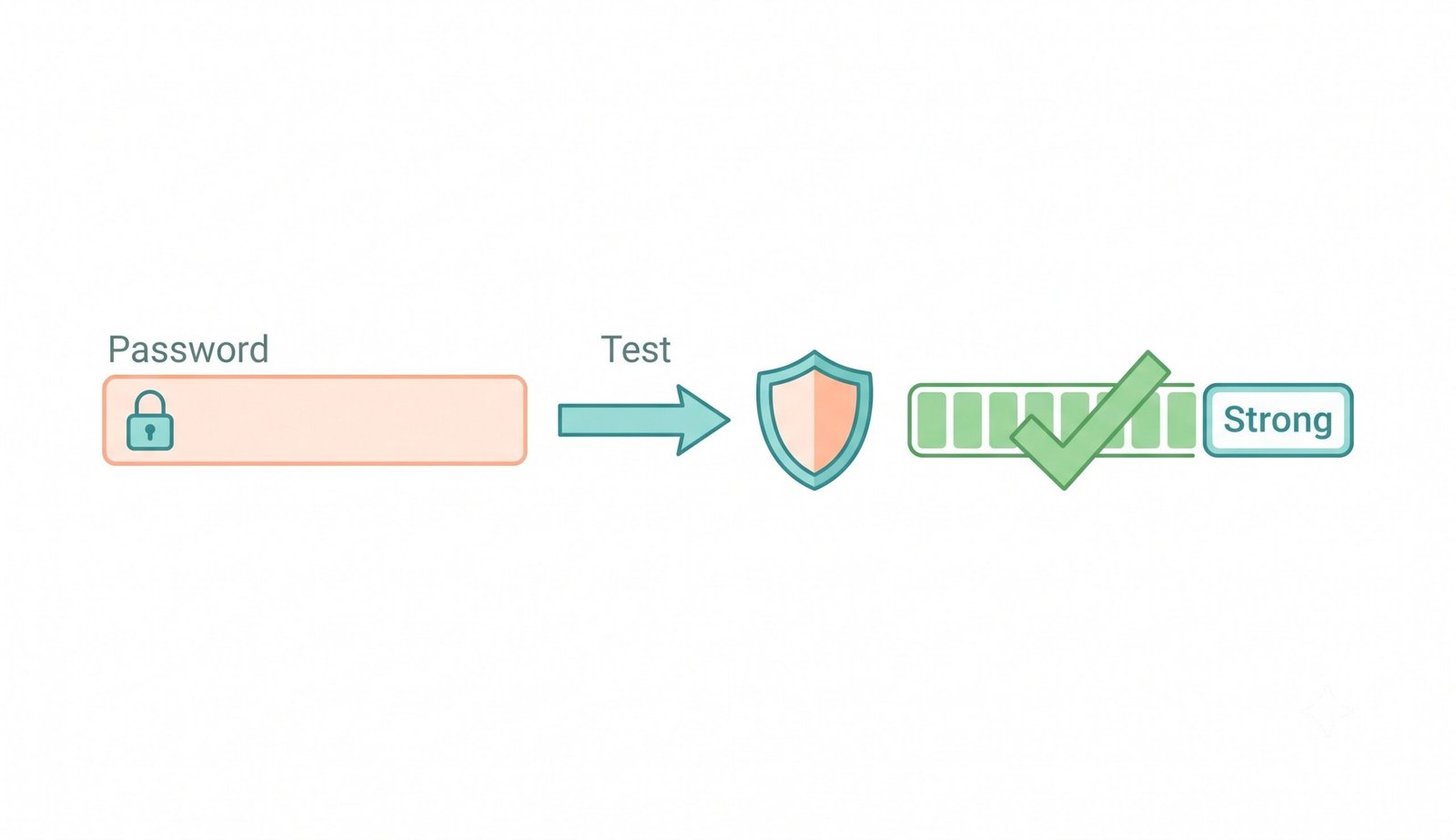
How to Test Password Strength in 3 Easy Steps
A lightning-fast, 100% private security workflow engineered to audit entropy and brute-force crack resilience.
Type or Generate Passphrase
Deep Entropy & GPU Audit
Harden & Export Audit Card
How Our Password Strength Testing Engine Works
Learn the cryptographic principles, Shannon entropy mechanics, and hardware brute-force calculations powering our studio.
Zero Keystroke Sandboxing
Your password string enters an isolated browser memory heap. No network packets, telemetry, or third-party cookies touch your credentials. Evaluation is 100% offline.
Adjusted Shannon Entropy Calculation
Our algorithm computes true theoretical entropy in bits using logarithmic symbol space (log₂ N^L). It dynamically deducts points for sequential keys, repetitions, and common dictionary roots.
100 GH/s Multi-GPU Attack Modeling
We simulate high-performance enterprise cracking clusters executing 100 Billion hash comparisons per second to accurately estimate how long a brute-force rig would take to exhaust your keyspace.
One-Click Passphrase Hardening
When predictable weaknesses or dictionary vocabulary are detected, our smart hardener injects phonetic l33t substitutions, special symbols, and CSPRNG salts to escalate entropy past 90 bits.
Key Security & Diagnostic Features
Built for developers, cybersecurity specialists, and privacy-conscious users needing verifiable credential protection.
Time to Crack Visualizer
Find out exactly how long to crack my password against state-of-the-art multi-GPU hashcat clusters.
100% Client-Side Privacy
No network calls, zero keystroke logs, and no cloud exposure. Evaluation runs entirely on your local CPU.
Shannon Entropy Calculator
Advanced password entropy calculator measuring true mathematical randomness in logarithmic bits.
Linguistic Pattern Detection
Identifies keyboard sweeps ('qwerty', '12345'), repeating chars, and common dictionary vocabulary.
One-Click Passphrase Hardener
Automatically upgrades vulnerable passwords into high-entropy passphrases with one simple click.
DSLR Security Audit Export
Generate and download high-resolution security report cards with professional studio aesthetics.
The Ultimate Guide to Password Strength & Cryptographic Entropy
Ensure your digital life is completely secure. Our highly advanced password strength tester allows you to safely check password strength online without any server uploads. If you've ever wondered how long to crack my password, our secure password checker provides instant, mathematically grounded audit reports.
Mathematical Foundations: Shannon Entropy in Password Auditing
Password security is fundamentally governed by combinatorics. Our password entropy calculator evaluates credentials by determining the total pool size N (lowercase, uppercase, digits, and special characters) raised to the password length L. The mathematical formula for nominal entropy is:
H = L × log₂(N). However, real-world attackers do not guess blindly. When you check password strength online, our tool subtracts empirical penalty scores for repeated glyphs, dictionary words, and keyboard sweeps like qwerty or 123456.
- Calculates true unpredictable entropy bits rather than naive character counts.
- Penalizes common phonetic leet-speak substitutions like
@foraand3fore. - Learn more about Password strength on Wikipedia to understand combinatorial complexity.
How Long to Crack My Password? Multi-GPU Attack Simulations
When evaluating credential safety, users want a concrete answer to: how long to crack my password? Automated cracking rigs (using Hashcat or John the Ripper) can test hundreds of billions of combinations every second against NTLM, MD5, and SHA-256 hashes.
Our secure password checker benchmarks your string against an aggressive 100 Billion attempts per second standard. While an 8-character password with mixed cases can be cracked in mere minutes, extending length to 14+ characters pushes the cracking time past centuries.
- Exponential search space growth: each added character multiplies cracking time by the symbol pool size.
- Protects against offline hash leaks and rainbow table dictionary exhaustion attacks.
- Recommends memorable multi-word passphrases with superior combinatorial security.
Client-Side Data Sovereignty: Zero Keystroke Logging
Typing credentials into an online tool can be dangerous if the site logs keystrokes or routes strings to cloud analytics. Our password strength tester guarantees 100% data sovereignty.
All computations execute strictly in your local browser sandbox. No databases, third-party trackers, or cloud servers ever receive your plaintext or hashed credentials.
- Complete offline functionality after initial page load.
- Zero analytics beacons, keystroke monitors, or remote session recordings.
- Export high-resolution DSLR-style security reports for professional compliance reviews.
Frequently Asked Questions
Everything you need to know about our private password strength tester and entropy diagnostic studio.
Yes! It is 100% safe to check password strength online with our studio because the entire calculation executes locally inside your web browser. Your keystrokes and plaintext passphrases are never uploaded, logged, or sent to any remote server or third party.
Our secure password checker calculates crack time by determining your adjusted Shannon entropy (combinatorial search space) and dividing it by an enterprise benchmark cracking rate of 100 Billion attempts per second (100 GH/s), modeling a dedicated 8x GPU cracking cluster.
Absolutely. Our platform functions as a precise password entropy calculator, providing exact mathematical metrics in logarithmic bits (log₂ N^L) and dynamically deducting points for predictable patterns such as repeated characters, keyboard sweeps, and common dictionary roots.
A strong password prioritizes length (at least 12 to 16 characters) and mixes diverse symbol pools (uppercase letters, lowercase letters, numbers, and special symbols) while avoiding predictable sequences like qwerty or standard dictionary words.
The Passphrase Hardener analyzes weaknesses in your typed string and automatically injects phonetic substitutions, boundary punctuation, and CSPRNG numeric salts to transform vulnerable phrases into military-grade credentials without compromising memorability.
Not at all! When you export your security score card, our client-side Canvas rendering engine generates a high-resolution, crisp graphic with expert studio color grading and sharp typography suitable for sharing on LinkedIn, Twitter, or developer portfolios.